


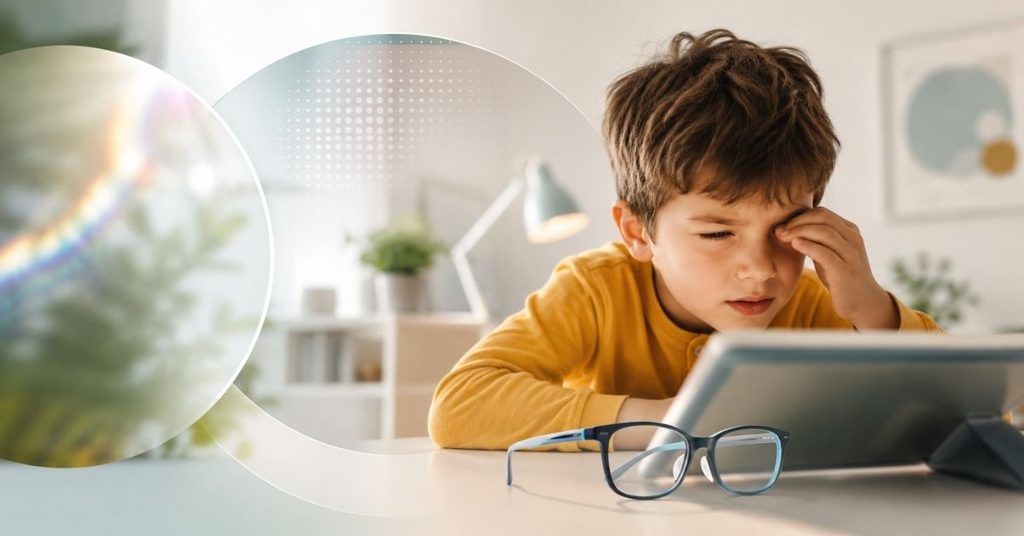
Children do not always say when their vision is blurry. If the whiteboard looks unclear, reading feels tiring or one eye is doing more work than the other they may assume that is simply how everyone sees. The first clues often appear in everyday behaviour: moving closer to the television, squinting, rubbing their eyes, avoiding reading or complaining of headaches.
Clear, comfortable vision plays an important part in reading, classroom learning, coordination and everyday confidence. Some childhood eye problems are also easier to manage when identified early. That is why recurring changes in the way a child reads, watches, plays or concentrates deserve attention.
Why Vision Problems Are Easy to Miss in Children
Adults can usually compare their eyesight with how clearly they used to see. Children often cannot. A child who has always been slightly short-sighted, long-sighted or affected by astigmatism may not realise their view is different.
Children also compensate. They may sit nearer the board, hold a tablet closer or avoid tasks that make their eyes uncomfortable. What looks like boredom or poor concentration can sometimes be a practical response to visual difficulty.
One symptom on its own does not prove that glasses are needed. The pattern matters. A headache after a long day may have many causes; repeated headaches combined with squinting, close viewing or reading difficulty are a stronger reason to arrange a sight test.
Common Signs Your Child May Need Glasses
Squinting to See Clearly
Squinting can make a blurred image seem temporarily sharper. You may notice your child screwing up their eyes when watching television, reading signs or trying to see the board at school.
Frequent squinting, especially when looking into the distance, can be associated with short-sightedness and is worth checking rather than dismissing as a habit.
Sitting Very Close or Holding Things Near the Face
A child who regularly sits close to the television, holds books unusually near or brings a tablet close to their face may be trying to make detail easier to see.
Occasional close viewing is not necessarily a concern. It becomes more meaningful when it is their preferred position across several activities or when they also struggle to recognise people or read text at a distance.
Headaches or Tired Eyes After Reading
Some children can keep text clear only by making their eyes work harder. They may complain of headaches, tired eyes or difficulty continuing with homework after a relatively short period.
This can happen with focusing difficulties or long-sightedness, although headaches have many possible causes. A sight test can help establish whether vision is contributing.
Rubbing, Blinking, Closing One Eye or Tilting the Head
Regular rubbing can be caused by tiredness, allergy or irritation, but when it happens mainly during reading or close work, visual discomfort is another possibility.
Closing or covering one eye deserves particular attention because a child may do this when their eyes are not working comfortably together. Tilting the head can serve a similar purpose.
Losing Their Place or Avoiding Reading
Watch how your child reads, not only whether they know the words. Repeatedly losing their place, skipping lines or becoming tired quickly during close work can justify an eye check.
Some children begin avoiding reading, drawing, puzzles or detailed craft activities because those tasks feel uncomfortable. These signs do not automatically mean glasses are required, but they are useful information for an optometrist.
Difficulty Seeing the Board or Distant Objects
A short-sighted child may see books clearly but struggle across the classroom. They might ask to sit nearer the front, copy notes incorrectly, fail to recognise someone at a distance or say that the board looks fuzzy.
Teachers can be valuable observers. If your child’s teacher notices a clear difference between close-up work and board work, mention it during the eye test.
Changes in Coordination or Confidence
Vision helps a child judge position, movement and distance. Frequent misjudging of steps, bumping into objects or a new lack of confidence catching a ball can be worth checking, particularly when it occurs alongside other visual signs.
Clumsiness by itself does not mean a child needs glasses. A persistent change from their normal behaviour is more significant.
How the Signs Can Change With Age
Toddlers and Pre-School Children
Young children may not have the words to describe blur or eye strain. Parents are more likely to notice an eye turning in or out, frequent eye rubbing, holding objects close, unusual head positioning or difficulty following objects with their eyes.
Importantly, children do not need to know letters before having their eyes examined. Optometrists can use pictures, shapes and techniques that do not depend on a child explaining what they can see.
School-Age Children and Teenagers
As schoolwork becomes more visually demanding, symptoms may appear as headaches, reduced reading stamina, difficulty seeing the board or a preference for larger text and closer viewing.
Do not automatically blame screens. If the same difficulty appears during print reading, sports or distance viewing in class, a proper sight test can provide a clearer answer.
What to Do If You Notice Several Signs
You do not need to work out the diagnosis yourself. If a symptom persists, affects school or everyday activities, or represents a clear change, arrange a sight test.
Before the appointment, it can help to note:
- whether the problem is mainly with near work, distance vision or both;
- how often headaches, rubbing or squinting occur;
- anything a teacher has noticed;
- whether one eye turns, drifts or is regularly covered;
- any family history of childhood squint, lazy eye or strong glasses prescriptions.
These details give the optometrist a better picture of what happens outside the consulting room.
In England, NHS sight tests are free for children under 16 and for 16-, 17- and 18-year-olds in full-time education. Eligible children who need glasses can also receive help towards the cost through an NHS optical voucher.
What a Children’s Eye Test Can Tell You
A children’s sight test is much more than reading letters from a chart. An optometrist can assess how clearly each eye sees, whether a glasses prescription is needed, how the eyes focus and work together, their alignment and the health of the eyes.
The examination can be adapted to a child’s age and ability. Pictures, matching symbols and objective techniques mean even younger children who cannot read can still have their vision assessed.
School vision screening is useful where it is offered, but it is not as comprehensive as a full sight test carried out at an optician’s practice. A previous school screening therefore should not stop parents arranging an eye test when symptoms develop.
For families in Sheffield, CitySpecs offers children’s eye tests at its Meadowhall practice, with examinations adapted to a child’s age, attention span and ability to respond.
When to Seek More Urgent Advice
Most of the signs above can be discussed through an optometrist appointment. Some symptoms need faster medical attention because they can indicate something other than a straightforward need for glasses.
Seek urgent medical advice if you notice:
- a white glow or white reflection in the pupil, including in flash photographs;
- a painful or swollen eye;
- uncontrolled or unusual eye movements;
- a sudden or significant change in vision.
A new or persistent squint should also be assessed rather than ignored, particularly if it appears suddenly or alongside other symptoms. NHS guidance advises urgent assessment for several of these warning signs.
Don’t Wait for Your Child to Say “I Can’t See”
The most useful signs of a childhood vision problem are often behavioural: squinting, moving closer, losing reading stamina, covering one eye or struggling with distance detail. None proves that glasses are needed, but recurring patterns are a good reason to arrange a professional eye test.
The goal is not simply to find a prescription. It is to understand whether your child’s eyes are seeing clearly, working comfortably together and developing as expected. A timely eye test can identify what needs correcting or reassure you that vision is not behind the difficulty you have noticed.
If you are looking for a children’s eye test in Sheffield, CitySpecs at Meadowhall can assess your child’s vision using age-appropriate testing and explain clearly whether glasses, monitoring or further care are recommended.
FAQs
Can a child need glasses without complaining about blurry vision?
Yes. Children may assume their vision is normal or adapt by sitting closer, squinting or avoiding difficult visual tasks.
At what age can a child have an eye test?
Children can have their eyes assessed from a very young age. They do not need to know letters or be able to read.
Are children’s eye tests free?
In England, NHS sight tests are free for under-16s and for 16-, 17- and 18-year-olds in full-time education.
Does sitting close to the TV mean my child needs glasses?
Not necessarily. If close viewing is consistent and comes with squinting or difficulty seeing distant objects, it is sensible to book an eye test.
How often should my child have an eye test?
Eligible patients can generally have a free NHS sight test every two years, or sooner when an optometrist considers an earlier test clinically necessary.


