


Most people book an eye test because something has already gone wrong. Road signs are softer than they used to be. Headaches turn up around four in the afternoon. The phone has quietly crept closer to the face over the past year. By the time any of that registers, the eye has usually been changing for a while.
Frame shopping has the opposite problem. People choose glasses the way they choose a coat: mirror, slight turn of the head, opinion from whoever came along. Then the glasses arrive and something is off. The reading zone sits in the wrong place. The frame slides down by lunchtime. The prescription gets the blame.
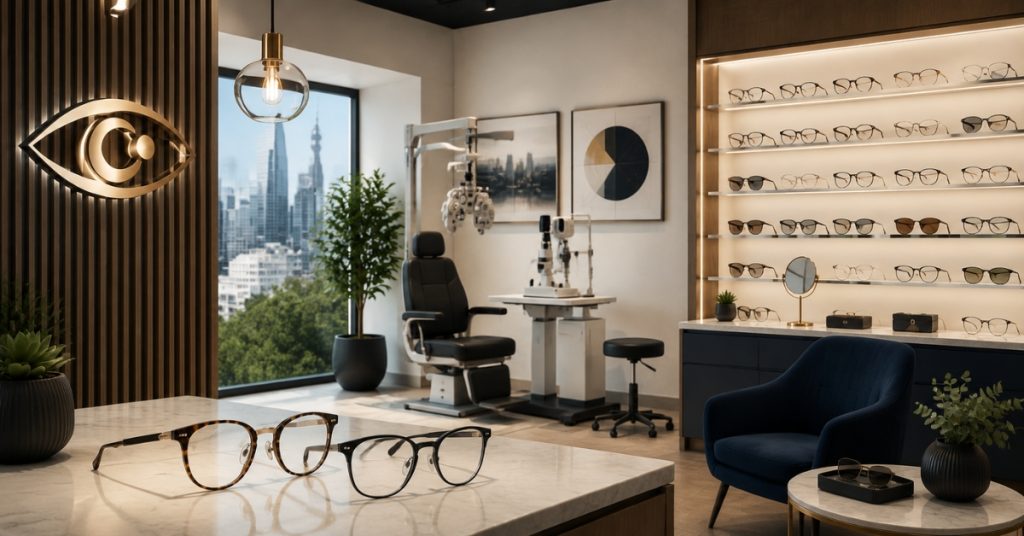
These two habits are why so many people end up wearing glasses that never quite work. The eye test and the frame choice are usually treated as separate errands, when in practice they are one chain, and the weakest link decides how well you see. That chain runs from what the optometrist can see inside your eye, through the numbers written on your prescription, into the millimetres that determine where the lens sits in front of your pupil. City Specs, the independent practice in Manchester’s Royal Exchange Arcade, is set up around that idea, and it shows in the equipment they have chosen to spend money on.
Where a routine sight test stops
A UK sight test is a real clinical examination. It measures how well you see, works out your prescription, checks eye pressure and peripheral vision, and includes a look at the back of the eye through the pupil. It catches a great deal.
What it struggles to do is look underneath the surface. The retina is roughly a quarter of a millimetre thick and built in distinct layers, and viewing it through the pupil is a bit like inspecting a lawn from a helicopter. You get the surface. You do not get the roots.
An OCT scan changes that. Optical coherence tomography sends light into the eye and rebuilds a cross section from the reflections, so those layers can be examined one by one. City Specs uses the Topcon Maestro2, which captures the scan and a colour photograph of the back of the eye in the same sitting, usually without dilating drops. The clinical reason is simple: glaucoma damage often begins in the nerve fibre layer long before anyone notices a gap in their vision, and early macular or diabetic changes can hide under a surface that still looks unremarkable.
The quieter benefit is the record. Your first scan is not especially dramatic. It is a reference point. Six years later, when the question is whether something has thickened, thinned or shifted, the comparison is the answer. Think of a 45-year-old whose grandmother had glaucoma. Nothing hurts, nothing looks wrong, and there is nothing to report. The scan is not there to find a crisis today. It is there so that when a question comes up later, there is something honest to compare against.
The millimetres that decide whether your lenses work
A prescription describes your eyes. It does not describe your glasses. The lens only delivers what the optometrist wrote down if it sits in front of your eye in the position the lab assumed when it was manufactured.
Several things have to be right for that to happen. Where your pupils sit horizontally. How high they sit within the chosen frame. How far the lens sits from the surface of the eye. The angle the frame tilts at, and how much it wraps around your face. Swap the frame and every one of those numbers changes.
In a simple single vision lens, being a couple of millimetres out is survivable. In a modern varifocal, where the clear corridor may only be a few millimetres wide, it is the difference between glasses that feel natural and glasses that have you tilting your chin at your laptop for six months before concluding that varifocals are not for you. Most varifocal complaints are not prescription failures. They are fitting failures.
City Specs measures this with the ZEISS VISUFIT 1000. Nine cameras fire simultaneously and build a 180-degree, three dimensional reconstruction of your head wearing the frame you have actually chosen. Pupillary distance is captured to a tenth of a millimetre, along with fitting height, pantoscopic tilt and wrap. It replaces the older method, which involved marking a demo lens with a felt tip while the patient sat very still and everyone hoped the frame had not been nudged.
Seeing yourself the way other people see you
That same capture produces a digital avatar of your face, and it solves a problem that has always been slightly absurd. If your prescription is strong, you take your glasses off to try new ones on, at which point you cannot see the frame properly in the mirror. Even with good vision, you only ever assess frames head on. Nobody else sees you that way.
The avatar lets you compare several frames side by side, in profile and three quarter view, on your own face. Lens options can be simulated on it too, so photochromic tints, mirror finishes and filters can be previewed before anything is ordered rather than discovered at collection. It sounds like a gimmick until you use it, and then it is difficult to go back to squinting hopefully at a mirror.
What you are actually paying for with designer eyewear
The word designer does a lot of work in optics, and not always honestly. Some frames are licensed: a fashion house rents its name to a manufacturer, and the frame underneath is ordinary. Others come from companies that are engineering businesses first, where the logo is close to beside the point.
Lindberg is the obvious example of the second kind. Danish, screwless, no rivets and no welding, built from titanium in weights measured in single grams. Fournines, from Japan, has a similar obsession with hinge design and metalwork. Montblanc sits in a different category again, and City Specs is an authorised stockist in Manchester. What these have in common is that the money is in the construction, not the branding.
Before you spend, it is worth knowing what to look at:
- The hinge fails first, because it is the only moving part you operate hundreds of times a week, usually one handed. Screwless and sprung designs age very differently from a cheap barrel hinge.
- Material decides repairability. Beta titanium can be bent back into shape again and again, cheap alloys fatigue and snap, and good acetate can be reheated and reshaped years later in a way injection moulded plastic cannot.
- The bridge carries most of the weight, so a frame that matches the shape of your nose will feel lighter than a physically lighter frame that does not.
- Ask whether temples, pads and screws will still exist in three years. That is what decides whether a future repair is a repair or a replacement.
- Check the frame against your prescription. A strong minus lens in a wide, deep frame gets thick and heavy at the edges, so the frame partly decides how good the lens can be.
This is where an independent has an advantage over a chain. The selection has not been narrowed to whatever a central buying team ordered in bulk, and the person advising you can say honestly that a frame is wrong for your prescription rather than steering you towards this month’s promotion.
The lens does more work than the frame
The frame gets all the attention. The lens does most of the work, and two people with identical prescriptions can walk out with completely different lenses depending on how they live.
Someone who spends nine hours between two monitors and then drives home in the dark has a different problem from someone reading paper all day. Occupational lenses widen the intermediate zone at desk distance, which stops the neck craning that varifocal wearers do without noticing. Anti-reflective coatings matter far more for night driving than most people expect, because the starburst around oncoming headlights is a coating and surface issue rather than a prescription issue. City Specs works with ZEISS lenses, including the EnergizeMe range, which is aimed at people who wear contact lenses all day and want glasses in the evening that do not feel like a penalty.
One honest note. Not everyone needs the top of the range lens, and a good dispenser will talk you out of things as often as into them. If nobody in the practice ever recommends the cheaper option, that tells you something.
The part nobody sells you: what happens six months later
Glasses move. You sleep on them once. You push them up your nose with a fingertip a thousand times. You leave them on a dashboard in July. The frame widens slightly, the fitting height drops by a millimetre or two, and the varifocal corridor you paid for is now sitting just below where your eye is looking.
This is why a practice you can physically walk into is worth more than the transaction that got you there. City Specs handles adjustments and small repairs in house, usually while you wait. Buy online and a loose hinge becomes a courier problem and a fortnight without your glasses. Buy locally and it becomes a five minute problem on a Tuesday.
Getting more out of your appointment
You will get better advice if you turn up with better information. A few things help more than people expect:
- Bring your current glasses, including the pair you gave up on. Knowing why they failed is useful.
- Measure the distance from your eyes to your main screen with a tape measure. Guessing this is the most common reason computer lenses disappoint.
- Mention symptoms that seem unrelated, such as headaches, glare at night, or one eye tiring before the other.
- Say what you actually do all day. Driving at night, needlework, reading music and standing at a lectern all pull the answer in different directions.
- Give a rough budget early. It makes the conversation more useful, not less, because it focuses the options on things you might actually buy.
What this adds up to
The distance between a good optician and an average one is not the letter chart on the wall. It is the depth of what gets measured, and whether it gets kept. A scan that shows the layers of your retina is only half the value; the other half arrives years later, when there is something to compare it with. A frame that suits your face is only half the job; the other half is the handful of millimetres that decide whether the lens does what the prescription promised.
Two things are changing in independent practice, and both point the same way. Eye records are becoming longitudinal rather than a snapshot, with software increasingly able to flag change between scans earlier than a tired human eye would. Fitting is becoming digital, with 3D capture replacing pen marks on a demo lens. The result should be fewer glasses that nearly work.
None of it removes the need for someone competent to interpret what the machines produce, and that part is unlikely to change. The practical advice is old fashioned and still correct: get tested before you notice a problem, ask what is being measured and why, and choose the frame with your prescription in the room rather than only a mirror.
Frequently asked questions
How often should I have an eye test?
Every two years suits most adults, which is the interval the NHS works to. Go sooner if your vision changes, if you are getting headaches or heavy glare when driving at night, if you have diabetes, or if glaucoma runs in your family. Children and anyone over 60 are usually seen more frequently. If your optometrist asks you back in twelve months, there is a reason.
What does an OCT scan show that a standard sight test cannot?
It images the retina in cross section, so the layers beneath the surface can be examined individually instead of viewed as a single surface through the pupil. Early glaucoma and macular changes tend to appear there first. It also creates a baseline, which is what allows a future scan to show whether anything has actually changed.
Why do measurements have to be taken again for every new frame?
Because the measurements describe the glasses, not only your eyes. Fitting height, the distance from lens to eye, and the tilt and wrap of the frame all change the moment the frame changes. Varifocals are the least forgiving of this, which is why they are the lenses people most often blame.
Are designer frames worth the extra money?
It depends what you are buying. A licensed logo on an unremarkable frame is a very different purchase from something like a Lindberg or a Fournines, where the cost sits in the hinge, the titanium and the fit. Ask what the hinge design is, whether spares will be available later, and how the frame handles your prescription. A modest frame that fits your bridge properly will outperform an expensive one that does not.
I have never got on with varifocals. Is it worth trying again?
Usually, yes. Varifocal failure is more often a fitting problem than a prescription problem, and current lens designs are calculated around measurements that older fitting methods could not capture accurately. If your last pair were fitted with a pen mark on a demo lens, a digital 3D fit is a different starting point altogether. It is not a guarantee, but it removes the most common cause of the problem.


