


A child-friendly eye examination usually involves looking at pictures or letters, following a small target, trying different lenses and having the eyes examined with a light. The optometrist adapts these checks to your child’s age and communication skills, explaining each step as they go.
For parents, knowing what those activities reveal makes the appointment easier to follow. Here is what you can expect, from settling into the consulting room to understanding the results. The order and choice of tests may vary according to your child’s needs.
Helping your child settle in
The first few minutes give your child time to meet the optometrist and become comfortable with unfamiliar equipment. A favourite toy can help, and you can usually stay beside them throughout the examination.
Beforehand, describe the visit simply: they will look at some pictures and let someone check their eyes. Avoid promising that every part will feel completely comfortable, since bright lights can feel unusual and drops, if needed, may briefly sting.
Bring their current glasses, medication details and any previous eye reports. City Specs’ guide to preparing for your eye test provides a useful checklist. Tell the practice in advance about communication needs or sensitivities to light and touch.
Talking through your child’s vision and health
The optometrist begins with questions about your child’s general health, development and eyesight. They will ask about previous eye treatment and family history, particularly squints, lazy eye or strong glasses prescriptions in childhood.
Describe specific things you have noticed, such as your child closing one eye, holding books unusually close or mentioning headaches. Explain when these happen and whether they are recent. These observations help guide the examination without assuming that a particular behaviour proves there is an eye problem.
Your child may also be asked how things look at school or during favourite activities, using questions appropriate to their understanding.
Checking what each eye can see
Vision is usually measured separately in each eye, with the other gently covered. This matters because a child may manage everyday activities using their stronger eye while reduced vision in the other goes unnoticed.
Older children may read letters that become progressively smaller. Younger children can name pictures or match symbols to a card. For children who cannot yet speak, the examiner can observe how they look at and follow suitable targets.
Checks may include both distance and near vision. Let your child answer independently, even if they hesitate or make mistakes. The aim is to find what they can actually see; there is no score they need to achieve to please anyone.
Measuring whether glasses would help
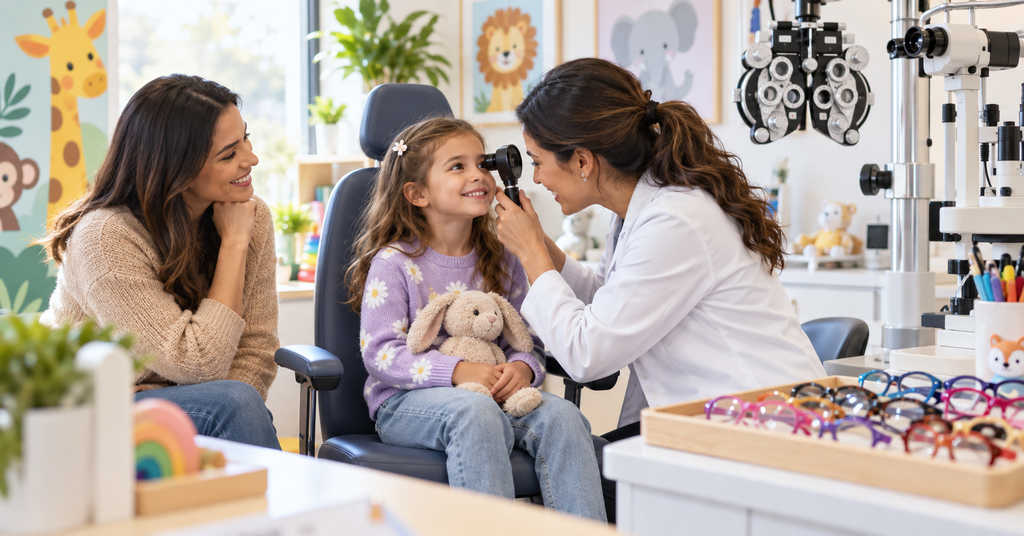
The prescription assessment, called refraction, checks for short-sightedness, long-sightedness and astigmatism. It helps the optometrist decide whether lenses would improve vision or support normal visual development.
One method is retinoscopy: the optometrist shines a light towards the eye and observes its reflection while placing lenses in front. Your child does not need to explain which view looks clearer for this measurement to be useful.
Children who can compare images may then look through different lenses in a testing frame or instrument. They might be asked which option looks sharper. Saying that both look the same is a valid answer. The prescription decision considers their age and the other examination findings too.
Seeing how the eyes work together
Your child may follow a small toy or light as it moves in different directions. The optometrist watches their eye movements and checks alignment.
A cover test involves briefly covering and uncovering each eye while your child looks at a target. Watching for movement helps the examiner assess whether the eyes are pointing together and identify a possible squint.
A depth-perception activity may involve spotting a picture that appears raised, sometimes through special glasses. This checks how the brain combines information from both eyes. These activities assess aspects of vision that reading a letter chart alone cannot show.
Examining eye health
The optometrist examines the front and back of the eyes using suitable lights and instruments. They assess structures such as the eyelids, clear front surface, retina and optic nerve, and may check how the pupils respond to light.
Your child may need to look in a particular direction or rest their chin on a support. The examiner explains what to do and can pause if necessary.
Colour-vision testing may be included when relevant, using pictures or patterns within coloured dots. Additional imaging, such as an OCT scan, depends on clinical judgement and suitability. Ask what any proposed scan will add and whether there is a separate charge.
Understanding why eye drops may be needed
Some children need drops that temporarily relax the eyes’ focusing mechanism and enlarge the pupils. Relaxing focus helps obtain a more accurate prescription measurement; enlarging the pupils gives a clearer view inside the eyes.
The optometrist should explain why drops are recommended and check relevant allergies or previous reactions. There is usually a wait for them to take effect, which can lengthen the visit.
Drops can sting briefly. Afterwards, close-up work may look blurred and bright light may feel uncomfortable. Effects depend on the drops used and can last into the following day, sometimes longer. Sunglasses or a sun hat may help outside. Ask how long the effects should last for your child and what to do if you have concerns.
Discussing the findings and next steps
At the end, the optometrist explains the results and whether your child needs glasses, monitoring or further assessment. If glasses are prescribed, ask when they should be worn and what to expect while your child adjusts.
A suspected squint, lazy eye or another concern may lead to referral to an orthoptist or ophthalmologist. Referral allows a specialist assessment and, where needed, a treatment plan.
Before leaving, confirm when the next check is due. The interval should reflect your child’s findings and visual development. If new concerns arise beforehand, contact the practice rather than waiting for that appointment.
Frequently asked questions
How long does a child’s eye examination take?
Ask when booking, as appointment lengths vary. Allow extra time if drops, additional measurements or glasses fitting are needed, and avoid scheduling another commitment immediately afterwards.
What if my child cannot complete the tests?
The optometrist can adapt the activities or offer a break. If reliable results remain difficult to obtain, they may arrange an early repeat visit or specialist assessment.
Can my child return to school afterwards?
Usually, yes. If drops were used, tell their teacher because reading may temporarily be difficult. Follow the examiner’s advice about activities while vision remains blurred.
Does school vision screening replace an eye examination?
No. Screening looks for reduced vision and identifies children needing further assessment. A full examination also assesses prescription needs, eye health and how the eyes work together.
Are children’s eye tests free in Sheffield?
NHS sight tests are free for children under 16 and young people aged 16–18 in full-time education. Eligible children needing glasses can also receive an optical voucher towards their cost.


